May 20, 2026
About the Author: Stefan Joubert

We’re honoured to shine a light on West Valley Guitars, a boutique guitar workshop known for its beautifully hand-built electric guitars, thoughtful design and exceptional attention to playability.
Behind the name is Josh Stopford, a dedicated guitar maker, repairer, teacher and musician whose life has been shaped by a deep love of guitars.
His instruments have been played by artists including IDLES, The Vaccines and Alberta Cross, and he has also worked on instruments for musicians connected with Gaz Coombes, The Stranglers, Massive Attack, Siouxsie and the Banshees, The The, This Is The Kit and many more.
Stefan: Can you take us back to the beginning?
What first drew you to guitars, and do you remember the moment when your fascination with the instrument truly began?
Josh: I grew up with music-loving parents.
My dad would bring home musicians who had played at the local pub the night before, Irish musicians mostly, and he’d have them stay over.
I remember waking up in the morning and coming downstairs for my cereal and the kitchen table being completely taken up by beardy men with beards and fiddles smoking cigarettes and still drinking whiskey from the night before.
I found that so intriguing.
They were like wizards or wise men and I wanted to be one of them when I grew up.
A strange aspiration I know!
Stefan: Your website mentions discovering your father’s acoustic guitar at around age 10 and later falling in love with your first electric guitar.
What was it about guitars that captured your imagination so strongly?
Josh: For a young boy in the 90’s guitars were as cool, if not cooler then having long hair and a cigarette hanging out of your mouth.
The way they make you feel when you hold them, the way people look at you when you wear them.
Aesthetically and creatively, they were the ultimate fashion accessory and seemed to unlock a more adult world that felt dangerous and exciting.
I became sort of enamored by that idea, that if you just had one of these things, it was like a superpower.
You could express yourself. You could become somebody else and, because it was a guitar, the musical scope was limitless.

“Josh and his love for the guitar”
A guitar is more than an instrument — it can become a symbol of confidence, creativity and personal expression.
Stefan: You studied music at Dartington College of Arts and later spent many years touring with Yes Sir Boss.
How did life as a working musician shape your understanding of what players really need from an instrument?
Josh: I think that coming from a player’s background gave me an appreciation of what’s important in an instrument.
What you need from it and what’s surplus to requirements, over-design or just pure gimmick.
Basically it gave me the fundamental notion that guitars need to look cool enough to inhabit a stage and strong enough to endure a life on the road.
They need to be beautiful and cool but just work and never let you down.
Stefan: After years of gigging, you retrained as a carpenter.
How did that move into woodwork eventually lead you towards guitar making?
Josh: It took me a few years to learn enough about carpentry to realise that I could build a guitar but once this dawned on me all other carpentry became uninteresting and I became completely guitar-focused.
I started building jigs after work on site and in the workshop.
I would take my guitar bodies into work with me and oil and wax and varnish them in my breaks.
And I would take guitar necks on holiday with me and refret them in the shed of my father-in-law’s house down in Cornwall!
It’s fair to say I caught the bug!
Stefan: You also spent time as a guitar-building instructor at Crimson Guitars.
How did teaching aspiring luthiers influence your own craft and way of thinking?
Josh: This was so formative for me.
Building so many guitars in a short space of time with the students really accelerated my learning.
It taught me how to solve problems, how to overcome challenges and mistakes, and also where the hard and blurred lines are in guitar building.
Where the maths and aesthetic begins and ends and where those two things can work together.
Stefan: Your guitars are described as modern boutique instruments rooted in classic design.
How would you describe the West Valley identity to someone discovering your work for the first time?
Josh: I’m half American and have been inspired by American pop culture all of my life.
Kerouac, Dylan, Waits, Tarantino!
I want my guitars to embody the best parts of that post-mid century American culture with its brash boldness, its confidence and a free spirited optimism.
However, I’m also half English so I want to bring that notion of fine, boutique, European craft.
Not the mass production of America but the artisanal craftsmanship of a man in his workshop, engrossed in making lovely things.
All of that in the shape of a guitar! It’s a tall order I know!

Where the First Guitar Took Shape
Every model begins somewhere — with a first shape, careful measurements, and the quiet confidence to start building by hand.
Stefan: The Indiana range has a very distinctive feel and visual character. What inspired the shape, style and personality of these instruments?
Josh: When I sat down to design my first model, The Indiana, I knew I wanted to make an offset that straddled the surf rock, Indie rock and Rockabilly worlds.
The 1950’s American car design had a big influence on me but I also knew that I wasn’t trying to reinvent the wheel so I took the vital measurements from a telecaster and started from there.
I didn’t use CAD or even photoshop to create my shape.
I drew it on MDF, cut it out and sanded it until I was happy.
It was all very old school!
Stefan: You build each guitar by hand, from the first cut of timber to the final set-up.
What does that slower, more considered process allow you to achieve?
Josh: Firstly it allows me to enjoy my work!
I can’t see that operating and maintaining a CNC all day is particularly rewarding for someone who loves to create things with their hands.
But when you pay a craftsman to do what they love, that love and care is immortalised in every cut and curve of the instrument.
This stuff matters. We’re humans and we have evolved over millennia to recognise the value of a handmade thing.
When it comes to the neck carve for example, I don’t select a CAD drawing and press go.
I play customers’ favourite guitars to get a feel of what they like and I can then intuit throughout the carving process what FEELS right.
Stefan: Your website places emphasis on carefully selected tonewoods, high-quality hardware and in-house hand-wound pickups.
How do these elements work together to create the final voice of a West Valley guitar?
Josh: Guitars are the sum of their parts to a certain degree, so using the highest quality materials and components is just a given really.
However, if you want to know what makes a guitar sound ‘good’ you’re getting into slightly subjective territory.
What I think is that everything makes a difference but there’s a hierarchy of variables.
People disagree on the order of these but I believe at the top, by a long way, is the pickups.
Electric guitars are NOT acoustic instruments after all, so although wood has a bearing on the sound, the electronics are the most influential component of an electric guitar’s sound.
This is why I take great care when I wind my pickups to voice them correctly or only choose pickup builders who take their craft really seriously.
Aside from tone and voicing guitars need to be sturdy, comfortable and hardy tools so using the correct woods and finishes is also vital for the longevity of an instrument that may spend its whole life being thrown in and out of vehicles and bashed around on stages!

One of Josh’s Proudest Moments
Seeing his guitar on stage in the hands of Justin Hayward-Young (The Vaccines’ lead singer) was a powerful moment — a quiet reminder of how far his craftsmanship had travelled.
Stefan: You have built guitars for artists including IDLES, The Vaccines and Alberta Cross.
What is it like seeing your instruments used by professional musicians on stage and in the studio?
Josh: It’s a thrill and a joy to see my guitars being played by professionals.
I designed my guitars to be stage tools and I can’t help but feel as though they are fulfilling their destiny when they are up there being thrashed in front of crowds.
However, it also brings me huge joy to know that some of my instruments are being loved and adored in a warm living room and hung lovingly on a wall overnight!
Guitars are for everyone, not just rock stars!
Stefan: You also offer guitar repairs and maintenance, including set-ups, fretwork and electronics.
How does repair work complement your guitar-building work?
Josh: I think a deep knowledge and intuition of the instrument you’re building is very helpful.
I would say, having handled such a huge range of guitars, I’ve acquired an understanding of the essence of the instrument and what the bench marks for quality are.
So now I know what I’m aiming for when I build a guitar.
I also take great care over my setups.
It’s always struck me as bonkers that you can buy a high end Fender or Gibson and have to take it straight to a luthier for a setup!
I must say that companies like Ibanez, Suhr and smaller makers are much more fastidious about only well setup guitars leaving their factories.
Stefan: Many adult learners only discover the importance of a good set-up after struggling with an uncomfortable instrument.
What difference can a professional set-up make to someone’s playing?
Josh: Setups are key.
A good setup can make a cheap instrument feel like a million bucks and vice versa.
A good setup should be tailored to the player AND the guitar.
Sometimes players bring me multiple guitars and I will set each one up differently depending on what tunings, string gauges and styles the guitars are being used for.
I also get a lot of older folks coming in with arthritis so choosing the right strings and tailoring setups to accommodate their physical limitations is transformative to their enjoyment of the instrument.
Setting up guitars is an art in itself and one of the most satisfying parts of my job.
I offer courses in setups for people who enjoy doing things themselves and they’re really popular.

Finding the One That Inspires You
A great guitar is not only chosen — it is felt. It should awaken something in you and make the idea of playing impossible to resist.
Stefan: For adult guitar learners buying their first quality electric guitar, what would you say are the most important things to look for?
Josh: Guitars need to attract you, so start by picking up whatever appeals to your sense of aesthetics.
Once you’ve got one in your hands, pay attention to the neck.
We all have different-shaped hands, and generally bigger hands prefer chunkier necks while smaller hands tend to like something slimmer and lighter-feeling.
Take the time to tune into what feels comfortable.
When you find something that looks right and feels good in the neck, sit with it unplugged for a while.
Do your fingers move around freely?
Does it invite you to play?
Does it sit comfortably against your body?
Then plug it in and make sure the pickups sing to you.
Think about your favourite players and what gave them their sound.
If you love B.B. King, you’re probably not going to want super-hot humbuckers in an Ibanez RG Jem.
And finally, guitars need to be paired with their amp soulmate.
They work symbiotically, and if you buy a terrible amp, your guitar will never forgive you.
Stefan: Are there any common mistakes players make when choosing, modifying or maintaining their guitars?
Josh: It’s easy to fall into the trap of thinking that buying gear or tinkering and modding is a substitute for learning how to play properly.
After all, it’s a lot easier to scroll through Reverb than it is to do the hard work of learning your scales.
Also, we guitarists tend to obsess over string buzz and let it dominate our playing experience.
Much of the time string buzz is bad technique as much as bad setup.
I also advice players to ignore buzz unless it’s amplified.
Guitars are old pieces of technology and they’re instruments, not formula one cars.
They don’t need to be perfect, they need to be characterful.
Stefan: You offer courses in set-up, rewiring, refretting, neck building and full electric guitar building.
What do students usually find most surprising when they begin learning how guitars are made?
Josh: Whether you’re learning to build or setup, it’s all a process of demystification.
It’s learning where the maths begins and ends and that what works for one person won’t for another.
Students find there are less hard rules than you’d think.
Also, students are always surprised at what they can achieve, especially when they build their first guitar.
Electric guitar building is a very long series of relatively simple processes, and with the right guidance and techniques you don’t even need wood working experience to build a simple electric guitar.
Stefan: What do you enjoy most about teaching people how to build, repair or understand their instruments more deeply?
Josh: It’s a joy to watch people surprise themselves and realise they can do something they never in a million years thought possible.
Stefan: For someone who has never stepped into a luthier’s workshop, what part of the building or repair process might surprise them most?
Josh: The lack of big machinery in my workshop surprises people but I do my initial timber prep in a joinery workshop down the road.
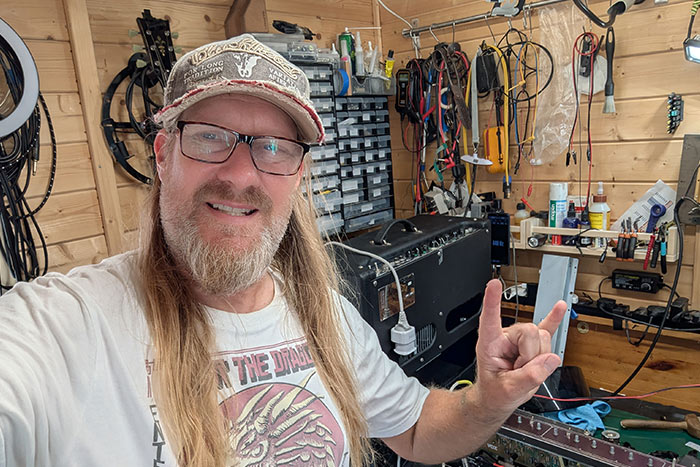
However, once the bodies are joined and everything is thick, people are surprised what can be done in a 7m x 5m room with a router table, bandsaw, drill press and wall of hand tools!

Josh’s Guitar with IDLES
One of Josh’s handmade guitars in the hands of an IDLES guitarist — a proud moment where craftsmanship meets the energy of the stage.
Stefan: Is there a particular build, repair or artist project that stands out in your memory as especially meaningful, unusual or rewarding?
Josh: Building for artists I love is incredible.
IDLES was a huge moment for me and I’m currently building a guitar for Eagles of Death Metal, which is extremely exciting.
However, a stand out build for me was a custom neck for an older chap who suffered horribly with arthritis.
It was stealing his passion from him and so I built him a smaller custom neck with a very specific carve, especially around the first 5 frets to ease pressure on his thumb joint.
It transformed his playing experience and he got his hobby back.
That was a really rewarding moment for me.
Stefan: What is the most fulfilling part of your day-to-day life as a luthier and guitar maker?
Josh: Being in my own space with the fields out my window, being my own boss surrounded by guitars!
Stefan: Conversely, what are some of the most challenging aspects of building handmade guitars?
Josh: With hand made craft comes human error and sometimes that can be crushing.
Financial margins are so tight and one mistake can mean you’re working for nothing for the rest of the week.
That hurts.
I also really struggle with the inherent social media necessity.
I really wish that I could just be a guitar builder rather than also having to become a marketing genius, algorithm expert and champion sales person.
It’s a lot of plates spinning and one can often feel overwhelmed.
Stefan: For players considering a custom or built-to-order instrument, what should they think about before commissioning a guitar?
Josh: If you’re considering a custom build (and I would highly recommend it!) I would say just call me for a chat.
The best thing to do is discuss it.
There’s so much to talk about and it’s such a fun process.
Clicking buy is boring and soulless.
Designing and speccing a custom guitar will be one of the funnest and most rewarding things you’ll ever do.

A Luthier’s Knowledge
A luthier’s work is not only about making instruments — it is about understanding every detail that helps a guitar feel alive.
Stefan: What advice would you give to guitarists who want to take better care of their instruments at home?
Josh: Come and do a course with me!
It shouldn’t be a chore.
It can become a passion in itself.
Stefan: Finally, what is the best way for someone to get in touch with you, and is there anything exciting currently happening at West Valley Guitars?
Josh: I’m releasing a new model in September called the Fever.
It’s a stripped back, little sister of the Indiana, designed to be more affordable.
It has a great range with a Standard model, a relic version, a Deluxe version and a bass model.
Email me for more info and to pre-book a build slot.
I’m also building a guitar for Jesse Hughes, frontman of Eagles of Death Metal which I’m buzzing about.
The brief is simply: Evel Knievel! I love that band!
I have a few choice stock Indiana’s on my website available for immediate purchase and books are open for the reminder of 2026 and 2027.
You can email me at info@westvalleyguitars.co.uk, call me on 07923546957 and see my work at www.westvalleyguitars.co.uk.
Josh, thank you ever so much for offering your time and insight.
It has been a real pleasure learning more about your journey, your work as a guitar maker, and the passion behind West Valley Guitars.
Your background as a musician, carpenter, teacher and luthier gives your instruments a truly personal voice, and your commitment to tone, playability and craftsmanship is deeply inspiring.
We’re delighted to feature your work as part of our Luthier Spotlight series, and we wish you continued success in all that you do.

After studying music at Dartington College of Arts, spending over a decade on the road with the indie/ska band Yes Sir Boss, retraining as a carpenter, and working as a guitar-building instructor at Crimson Guitars, Josh founded West Valley Guitars in 2018. Today, from his Somerset workshop, he builds refined, distinctive electric guitars for players seeking something personal, responsive and beautifully made. Get in touch with him by email at info@westvalleyguitars.co.uk and discover his exceptional work at www.westvalleyguitars.co.uk.

RELATED POSTS