March 25, 2026
About the Author: Stefan Joubert

For many guitarists, barre chords mark a turning point.
They open the door to a far wider harmonic vocabulary, greater freedom across the fretboard, and a more mature, versatile way of playing.
Yet for all their usefulness, they can also be one of the most uncomfortable aspects of learning the guitar, particularly for adult students who are trying to develop strength and control without unnecessary tension.
It is very common for players to experience discomfort when first working on barre chords.
In many cases, this does not mean anything is wrong with the guitar, the hand, or the student’s ability.
More often, it is a sign that too much force is being used, that the body is working inefficiently, or that the player is holding tension in places that do not need to be involved.
At the London Guitar Institute, many adult students come to us feeling frustrated by barre chords.
They often assume the solution is simply to press harder and push through the pain.
In reality, the opposite is usually true. Good barre chords rely far more on balance, alignment, and technique than on brute strength.
Once this becomes clear, the entire experience can begin to feel much more manageable.

Why Barre Chords Can Cause Wrist Pain
The wrist is a small but highly important part of the playing mechanism.
When it is forced into an awkward position for long periods, strain can build up very quickly.
Barre chords often trigger this because students instinctively try to clamp the neck with the fretting hand, over-bend the wrist, or squeeze far harder than necessary in an attempt to make every note sound clean.
This creates a chain reaction.
The thumb presses too hard at the back of the neck, the wrist collapses forward, the forearm tightens, and the fingers become rigid.
Instead of allowing the hand to work in a free and coordinated way, the player ends up battling the instrument.
A little fatigue during technical practise can be normal.
Sharp pain, persistent discomfort, or a feeling of strain that worsens the longer one plays should never be ignored.
These are signs that something in the setup or approach needs to change.

The Difference Between Effort and Strain
One of the most important things to understand is that barre chords do require effort, but effort is not the same as strain.
A good barre chord may feel demanding at first, especially if the hand is not yet used to the shape.
However, it should not feel as though the wrist is being twisted, crushed, or forced into place.
There is a great deal of productive work in guitar playing that feels focused and active without becoming painful.
Many students benefit from asking a simple question while practising: am I working, or am I fighting?
If it feels like a fight, there is usually too much tension somewhere in the system.

Check the Position of the Wrist
The wrist is often the first place to look.
When students struggle with barre chords, they frequently bend the wrist too sharply so that the hand can reach around the neck.
This may seem helpful in the short term, but it usually creates more pressure and less freedom.
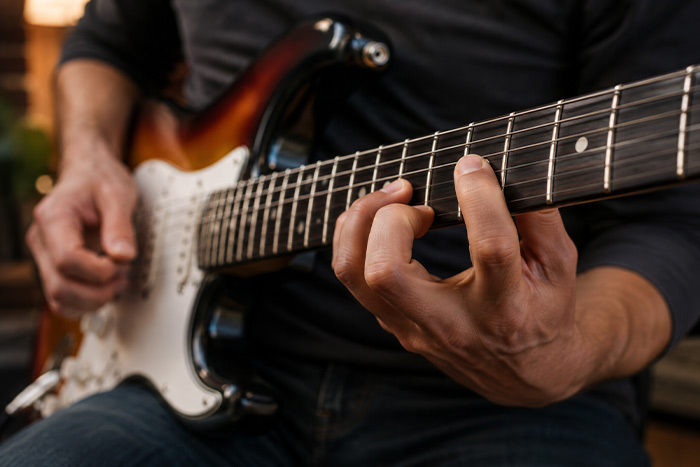
Ideally, the wrist should remain reasonably neutral.
It does not need to be perfectly straight, but it should not be heavily collapsed either.
A severely bent wrist places unnecessary stress on the tendons and makes it harder for the index finger to apply even pressure across the strings.
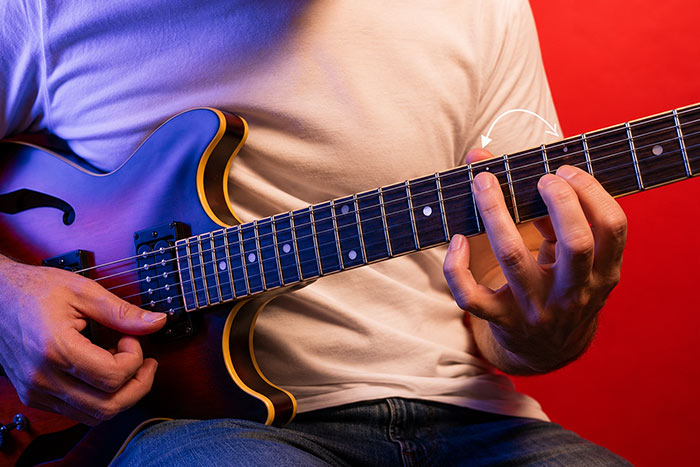
A more balanced setup usually comes from adjusting the whole arm rather than just the hand.
Bringing the elbow slightly forward or under the guitar can help the fingers approach the fretboard from a better angle.
Very often, a small change in arm position produces a major improvement in comfort.

Let the Arm Help the Hand
Many players try to create a barre chord using finger pressure alone.
This is exhausting. The fretting hand should not be doing all the work by itself.
Instead, it is often far more effective to let the weight and position of the arm assist the chord.
When the arm is aligned well, the index finger can rest into the strings with support from the whole playing mechanism, rather than clamping through isolated tension in the hand.
This does not mean hanging heavily on the neck or becoming stiff.
It simply means understanding that the hand is part of a larger structure.
The shoulder, arm, wrist, thumb, and fingers all influence one another.
Barre chords become much easier when the workload is shared intelligently.

Do Not Squeeze Harder Than Necessary
One of the great surprises for many students is that most barre chords do not require nearly as much pressure as they think.
When a chord buzzes or one note refuses to sound, the instinct is usually to squeeze harder.
This sometimes works for a moment, but it encourages bad habits and quickly leads to fatigue.
The better approach is to refine the contact.
The index finger does not have to lie completely flat and force every string down with equal effort.
In fact, many players get a cleaner result by using the slightly bonier side of the finger rather than the soft centre.
Small adjustments in finger angle can make a remarkable difference.
It is also worth remembering that the finger should be placed close enough to the fret to reduce the amount of force needed.
If the barre sits too far back, more pressure will be required and the wrist will work harder than it should.

Pay Attention to the Thumb
The thumb plays an essential supporting role, but it should not become a vice.
In healthy barre-chord playing, the thumb generally sits behind the neck in a position that supports balance rather than brute force.
If the thumb wraps excessively, pushes too hard, or locks into place, tension will build very quickly through the wrist and forearm.
The thumb should feel responsive, not rigid.
It may move slightly depending on the chord shape and the size of the player’s hand, but it should not feel as though it is desperately trying to crush the neck from the opposite side.
A useful experiment is to form the chord lightly, release some of the thumb pressure, and notice how much force is actually needed.
Many students discover that they can reduce the effort considerably without losing control.

Practise the Shape in Stages
Trying to hold a full six-string barre chord for long periods is rarely the best way to improve.
It is much more effective to build the skill gradually.
A student might begin by practising partial barres, perhaps using two or three strings first, before extending the shape.
This allows the hand to learn the principle of the movement without overwhelming the wrist.
It can also help to isolate the elements of the chord.
For example, one might first place the barre alone, then add the remaining fingers afterwards.
This makes it easier to identify where the tension really begins.
Breaking the problem into smaller pieces often leads to quicker progress and less frustration.
It also encourages careful listening and awareness rather than mindless repetition.

Avoid Long Repetitive Drills Without Rest
Barre chords are one of those areas where determination can easily become counterproductive.
Repeating the same difficult shape again and again, especially when the hand is already tired, tends to reinforce tension rather than solve it.
Short, focused bursts of practise are far more effective.
A few thoughtful minutes spent placing the chord well, checking posture, and listening carefully will usually bring better results than twenty minutes of squeezing through discomfort.
It is wise to pause regularly, release the hand, and let the wrist return to a neutral position.
Gentle rest is not laziness. It is part of intelligent technical work.

Make Sure the Guitar Setup Is Not Making Things Worse
Sometimes the student is blamed for a problem that is partly caused by the instrument.
If the guitar action is very high, the neck is uncomfortable, or the strings are unusually heavy, barre chords may feel much harder than they need to.
A well-set-up instrument can make an enormous difference, particularly for adult learners who are still developing confidence.
If the guitar feels unreasonably resistant, it may be worth having it assessed by a teacher or technician.
This is not about making excuses.
It is about removing unnecessary obstacles so that technique can develop properly.

Build Strength, But Do So Sensibly
Strength does matter, but it should be developed through good movement rather than forced gripping.
As the hand becomes more familiar with barre chords, the necessary endurance will come.
The mistake is to chase strength before coordination.
If a player repeatedly uses poor alignment and excessive tension, they may become stronger at doing the wrong thing.
Good technical development is usually quieter and more patient than people expect.
It is built through consistency, accuracy, and careful repetition.
Over time, the hand becomes more capable, but ideally it also becomes more relaxed.

Know When To Stop
This point is especially important.
Discomfort that eases quickly once you stop playing may simply be a sign of overworking.
Pain that persists, worsens, or feels sharp should be taken seriously.
No chord is worth injuring yourself for.
If wrist pain continues despite improving your technique and reducing tension, it is sensible to stop and seek appropriate professional advice.
Guitar playing should be challenging at times, but it should not become physically damaging.

Closing Thoughts
Barre chords are often seen as a test of strength, but in truth they are a lesson in efficiency.
They teach the guitarist how to use the body more intelligently, how to release unnecessary effort, and how to create a clear sound without tension dominating the process.
When approached well, they become far less intimidating.
The wrist feels freer, the hand works more naturally, and the player gains not only cleaner chords but a healthier overall technique.
At the London Guitar Institute, we place great importance on helping adult students develop strong foundations without strain.
Technical challenges such as barre chords should be approached with clarity, patience, and musical purpose.
With the right guidance, students often discover that what once felt painful and impossible can gradually become controlled, comfortable, and entirely achievable.
If you are struggling with barre chords, it may not be a question of trying harder.
It may simply be a matter of learning how to use your hands, arms, and instrument in a more effective way.
That small shift in understanding can transform not only your chord playing, but your whole relationship with the guitar.

RELATED POSTS